Psychology #1
A little extra article. I noticed many of the readers I talk to have good plans, but what they struggle with the most is staying in control when things get bumpy.
Traders have three major enemies: FOMO, ego, and risk aversion.
Since we are normies, we struggle with this stuff every day.
So let me write down a few principles that helped me stay sane in this asylum. They mostly come from gigabrains and OGs.
They usually give you the "tag line" because it makes sense to them. However, we are severely retarded compared to them, so I will break down the meaning of it so we can understand what they mean on a day-to-day basis.
1. Don't fade the trend
This one seems easy, and it's the one I personally struggle with the least, unlike many folks out there.
For some obscure reason, people want to catch reversals and bounces against the trend.
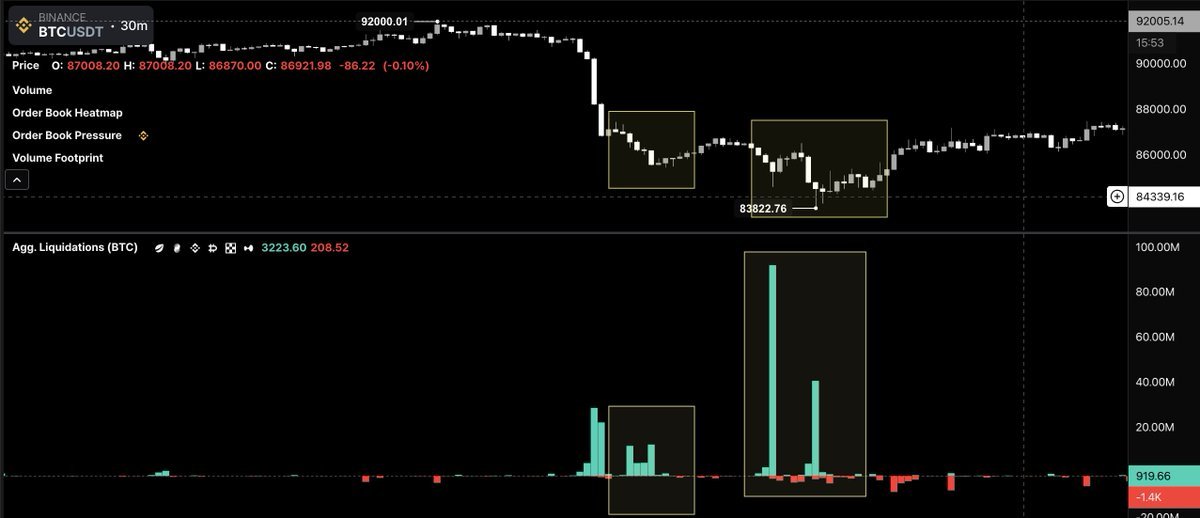
Let's play a game. Go on @kiyotaka_ai, set a 30-minute candlestick $btc chart and add the aggregate liquidations indicator.
Just look at December 1st, 2025 sudden price drop. On the price chart, I highlighted the areas where people rushed to catch knives, and on the liquidation indicator you find the corresponding yellow rectangle.
Want this to be you, Anon?
It's really f*cking exhausting to watch these things happen live, because the guys getting liquidated here are probably retailers. THIS. IS. AVOIDABLE.
I have published a lot about how to spot exhaustion and end of impulse on charts (especially with the footprint), but that doesn't mean that you have to go catch falling knives.
Aside from the fact that countertrend bounces are generally short-lived, they have very little R/R ratio. I'm not saying contrarians are idiots. I think the profitable ones are gigachads.
However, the number of individuals who are consistently profitable on contrarian trades are extremely low.
Chances are, you are not an outlier.
If you see a trend day, seek an entry in favor of the trend, rather than waiting for a bounce/correction. You want to trade the trend as early as possible. If you are late, don't try to time a knife catch on a counter move.
If you are late and mom
entum is depleting, wait for it to pass and then position with the major trend again during the next move. You missed the train, another one will come.
Think about it: you missed the obvious move, do you think you can intercept the difficult one? You have a big ego, Anon.
Leave your ego at the door when you walk into the market.
It's part of the game.
2. Let the market come to you.
What on earth does this mean?
We have to zoom out a bit. Let's say you expect a certain move, and guess price will reach a certain area where you can reasonably open a short position and skim a few % points down to a certain level.
Let's say you're right. Let's also say it will take a few days to get there.
You can fuck this up in two ways:
a. by riding the price UP to make another little profit, while having no idea about HOW the price will get to your short entry point. You get stopped/liquidated on your way there.
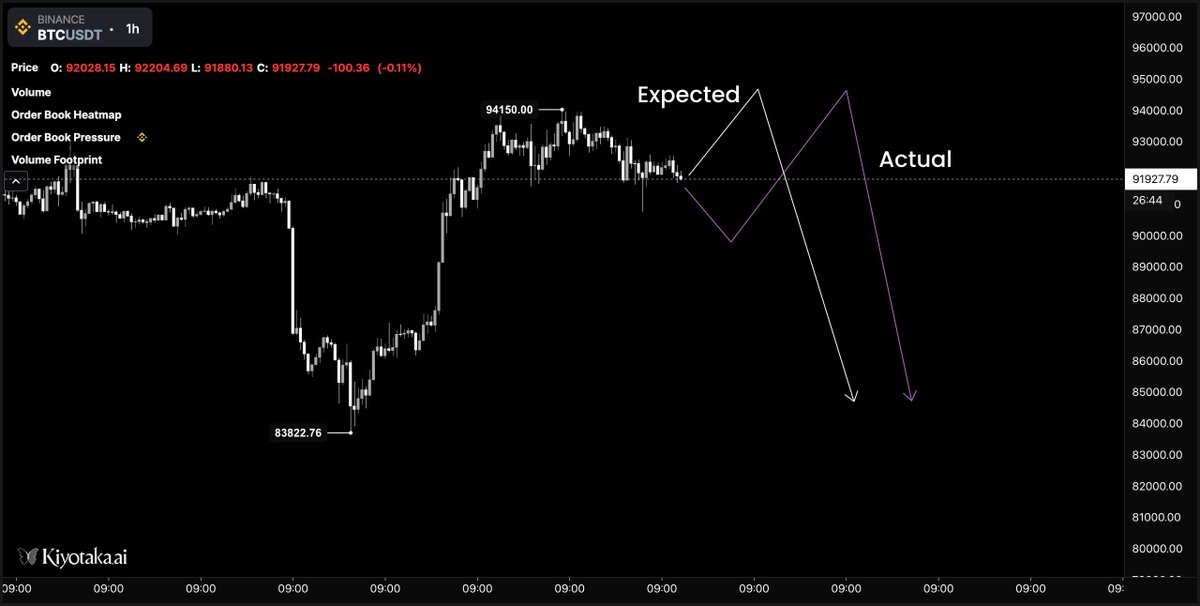
If you short on the first price drop and you planned to short at 95k, you are at risk.
b. anticipating the short by opening it before your reversal confirmation because "ohh it's nuking". You get stopped/liquidated on your way there, again.
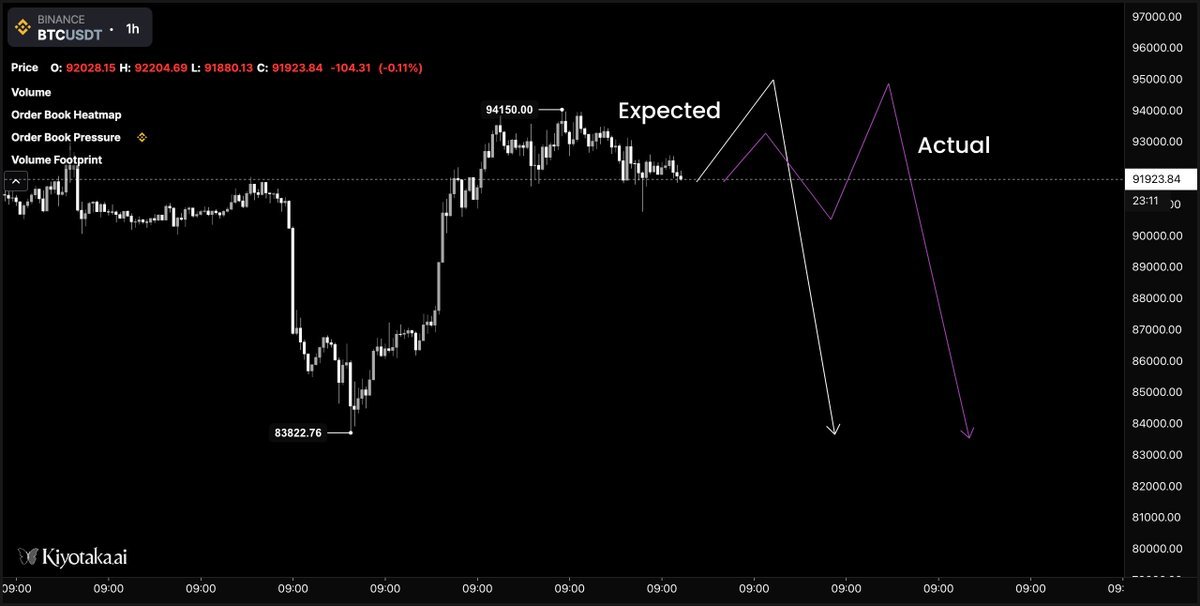
You short the first fakeout despite having planned to short at 95k.
These are trades that you can avoid, because they don't fit your plan
Two reasons to avoid them, both can alternatively be true:
- You might be wrong, and then you have no plan if you get in early.
- You are right, but you are too early.
If you have a plan, wait for the market to get you to the level of your trade setup. Set some invalidation conditions to decide when your plan is no longer viable and make a new one.
Until proven wrong, wait. Set alerts. Do something else.
3. This has to be boring
Many of you, at some point in life, probably took a driver's license and drove a car for the first time, or took your first airplane flight, or some other "first" you were looking forward to. First school presentation, first phone, whatever.
How did it feel? Chances are, you felt some excitement, some nervousness, some sort of strong emotion.
Now have a look at the truck drivers, the airline million milers, the PhD student on his 1000th lab meeting presentation, the guy who does 30 phone calls a day for work.
Do you think they're excited? Do you think they feel any emotion? They feel nothing at best, and feel dead inside at worst.
Look at the businessman at the airport. He's on his 12th flight this month. He can sleep through the take-off.
This is how this has to feel. Like the truck driver, he sets the route and starts driving. It's just another day at the job. Sure, something cool might happen that day, but that's one day every few months.
You have to do this sh*t so many times, you don't feel anything at all. That's when you're in control of the situation.
Like the truck driver who has been on the road for 10 years. He knows every corner of the route. He can anticipate where heavy traffic is and avoid it, he can see an oil patch on the road from 500m away. And probably drives better and more safely than the guy who just got his driver's license and is still too excited to pay attention at the road.
Write these three things down on a Post-it and stick it to your desk. That's what I did years ago, and the Post-it is still there.
Stay safe, babes.
Until next time.